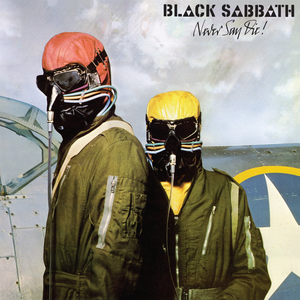
Never Say Die
Black Sabbath
Bill Ward, Ozzy Osbourne, Tony Iommi +1
Listen to the Song
At a glance
- Key
- A Mixolydian
- Time signature
- 4/4
- Main progression
- I–bVII–IV–I
- Chords used
- A · G · D · E · Bm · A5 · G5 · D5
Summary
Released in 1978, this title track stands as the final single from Black Sabbath’s original lineup before Ozzy Osbourne's initial departure from the group. It marks a stylistic shift toward an energetic, radio-friendly sound that contrasts with the band's earlier doom-laden compositions. The song’s theme of perseverance reflected the members' personal struggles with substance abuse and internal tension during the Toronto recording sessions.
Chord Sheet
Chords Used
Progression by Section
Bridge
Chorus
Verse
Chord Diagrams
Musical Analysis
Never Say Die represents a significant harmonic shift for Black Sabbath, moving away from the minor-key tritones and chromaticism of their early 'doom' era toward a major-key hard rock sound. The song's character is defined by the Mixolydian mode, where the bV…
History
The title was chosen as a phrase to sum up the band's previous ten years and the concept of never giving up. The writing process was complicated by vocalist Ozzy Osbourne briefly leaving the band and being replaced by Dave Walker, though Osbourne eventually re…
“Osbourne refused to sing any material written during Dave Walker's brief tenure with the band.”
Full musical analysis
Never Say Die represents a significant harmonic shift for Black Sabbath, moving away from the minor-key tritones and chromaticism of their early 'doom' era toward a major-key hard rock sound. The song's character is defined by the Mixolydian mode, where the bVII (G major) provides an uplifting, anthem-like quality. Tony Iommi utilizes the interaction between the E major (V) in the chorus and the G major (bVII) in the verse to oscillate between traditional tonality and modal rock structures, mirroring the defiant, energetic theme of the lyrics.
The title was chosen as a phrase to sum up the band's previous ten years and the concept of never giving up. The writing process was complicated by vocalist Ozzy Osbourne briefly leaving the band and being replaced by Dave Walker, though Osbourne eventually returned. Because the band often wrote material during the day and recorded at night, there was little time for revisions. Bassist Geezer Butler noted that last-minute lyric rewrites were common because Osbourne frequently rejected his initial drafts.
Released in 1978, this title track stands as the final single from Black Sabbath’s original lineup before Ozzy Osbourne's initial departure from the group. It marks a stylistic shift toward an energetic, radio-friendly sound that contrasts with the band's earlier doom-laden compositions. The song’s theme of perseverance reflected the members' personal struggles with substance abuse and internal tension during the Toronto recording sessions.
Some sections are still pending
6 of 12 sections are ready. Ask for the rest and this song moves up our analysis queue.
Song DNA
Genre
Metal
Era
70s
Mood
Defiant
Tempo
Upbeat
Key
Major
Texture
Full Band
Sound
Guitar-driven
Feel
Straight
Explore More
Explore related
Statistics
1.0M
Plays
227K
Listeners
25K
Genius Views
2
Annotations
100%
Popularity
5:37
Duration
4/4
Time