De colores (In Colors)
Joan Baez
Traditional
Listen to the Song
At a glance
- Key
- G major
- Time signature
- 4/4
- Main progression
- I–IV–V7–I
- Chords used
- G · C · D7
Summary
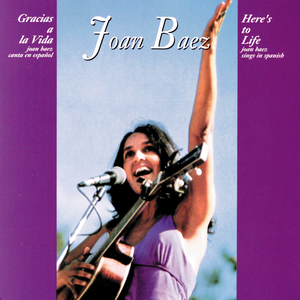
"De Colores" traces its roots to 16th-century colonial melodies carried from Spain to the Americas, later refashioned by Cursillo retreatants in Majorca in the 1940s and adopted as the unofficial anthem of Cesar Chavez's United Farm Workers. Joan Baez brought it to a new generation on her 1975 A&M album Gracias a la Vida, produced alongside Henry Lewy, letting the song's jubilant major-key waltz carry the same weight it had on picket lines and in church basements for decades. Its enduring life in elementary schools, labor rallies, and Catholic retreats is rare for any folk standard.
Chord Sheet
Chords Used
Progression by Section
Chorus
Verse
Chord Diagrams
Musical Analysis
"De Colores" is about as harmonically spare as a folk song gets — three chords, strictly diatonic, with no chromatic movement or secondary dominants. What has sustained it across centuries is the combination of waltz meter and an open major tonality that gener…
History
"De Colores" has no single known author. It traveled throughout the Americas from at least the 16th century, carried by melodies imported from Spain during the colonial era. One of its melodic lines shares material with the chorus of the Italian folk song "Bel…
“Henry Lewy was Joni Mitchell's longtime recording engineer and producer during her most celebrated period — his collaboration with Baez brought that same West Coast acoustic sensib…”
📝 Lyrics
joyful · devotional · celebratoryTheme
Celebration of color as an expression of joy, creation, and human unity
Surface
A catalog of colors found in nature — spring fields, birds, the rainbow — building toward a declaration that great love itself comes in many colors.
Deeper meaning
Color functions as a metaphor for abundance, diversity, and the richness of shared experience. Depending on context, the song carries a spiritual meaning — living in grace, bringing souls to a higher ideal — and a political one, as the Farm Workers movement adopted it as an anthem of solidarity across people of all backgrounds.
Symbols
Full musical analysis
"De Colores" is about as harmonically spare as a folk song gets — three chords, strictly diatonic, with no chromatic movement or secondary dominants. What has sustained it across centuries is the combination of waltz meter and an open major tonality that generates immediate communal uplift. The simplicity is the point: any gathering, regardless of musical training, can lock into this progression and sing together.
"De Colores" has no single known author. It traveled throughout the Americas from at least the 16th century, carried by melodies imported from Spain during the colonial era. One of its melodic lines shares material with the chorus of the Italian folk song "Bella ragazza dalle trecce bionde." Scholars broadly credit a group of Cursillo participants in Majorca, Spain, with shaping the modern lyrical version after one of the earliest Cursillo retreats in the 1940s — though the song itself predates that gathering by centuries. Authorship is listed simply as Traditional.
"De Colores" traces its roots to 16th-century colonial melodies carried from Spain to the Americas, later refashioned by Cursillo retreatants in Majorca in the 1940s and adopted as the unofficial anthem of Cesar Chavez's United Farm Workers. Joan Baez brought it to a new generation on her 1975 A&M album Gracias a la Vida, produced alongside Henry Lewy, letting the song's jubilant major-key waltz carry the same weight it had on picket lines and in church basements for decades. Its enduring life in elementary schools, labor rallies, and Catholic retreats is rare for any folk standard.
Some sections are still pending
7 of 12 sections are ready. Ask for the rest and this song moves up our analysis queue.
Song DNA
Genre
Folk
Era
70s
Mood
Uplifting
Tempo
Mid-tempo
Key
Major
Texture
Sparse
Sound
Acoustic
Feel
Straight
Explore More
Explore related
Listen & Learn
Statistics
39K
Plays
7K
Listeners
10K
Genius Views
1
Annotations
92%
Popularity
4/4
Time