I Am the Walrus
The Beatles
John Lennon, Lennon-McCartney
Listen to the Song
Search for videoSummary
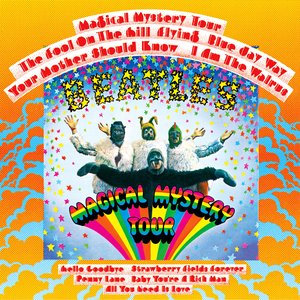
Released in 1967 as the B-side to 'Hello, Goodbye,' 'I Am the Walrus' is one of the Beatles' most daringly experimental recordings. Inspired by Lewis Carroll, childhood nursery rhymes, and a deliberate desire to baffle interpretation, Lennon's surrealist lyrics are set against George Martin's kaleidoscopic orchestral arrangement featuring strings, horns, clarinet, and a 16-voice professional choir performing nonsense vocals and shrill whooping noises.
Musical Analysis
The harmony of 'I Am the Walrus' is remarkably sophisticated for a 1967 pop single. Rather than following conventional diatonic progressions, Lennon constructs the verse around parallel major chords descending chromatically — a technique more common in film sc…
Chords
History
John Lennon wrote 'I Am the Walrus' by combining three unfinished song ideas. The first was inspired by hearing a police siren at his Weybridge home, prompting the 'Mister city policeman' lyric set to the siren's rhythm and melody. The second was a short rhyme…
“The Mike Sammes Singers were a professional 16-voice choir hired to perform nonsense vocals and whooping noises”
Full Musical Analysis
The harmony of 'I Am the Walrus' is remarkably sophisticated for a 1967 pop single. Rather than following conventional diatonic progressions, Lennon constructs the verse around parallel major chords descending chromatically — a technique more common in film scoring than songwriting. The contrast between the descending verse (B→E) and ascending chorus (C→D→E) creates a push-pull dynamic that mirrors the lyrical absurdism. The song persistently avoids clean tonic resolution, hovering around V and using ♭III and ♭VII to blur the sense of key center. George Martin's orchestral arrangement adds further harmonic density with chromatic countermelodies, making this one of the most harmonically adventurous songs in the Beatles' catalog.
John Lennon wrote 'I Am the Walrus' by combining three unfinished song ideas. The first was inspired by hearing a police siren at his Weybridge home, prompting the 'Mister city policeman' lyric set to the siren's rhythm and melody. The second was a short rhyme about sitting in his garden, and the third was a nonsense phrase about sitting on a cornflake. Unable to complete any of them separately, Lennon merged them into one deliberately bewildering composition. His childhood friend Pete Shotton contributed by recalling a playground nursery rhyme ('Yellow matter custard, green slop pie, all mixed together with a dead dog's eye'), from which Lennon borrowed imagery. Shotton also suggested changing 'waiting for the man to come' to 'waiting for the van to come.' The lyric included the phrase 'Lucy in the sky,' referencing the earlier Beatles song. The walrus character was drawn from Lewis Carroll's poem 'The Walrus and the Carpenter' from Through the Looking-Glass.
Released in 1967 as the B-side to 'Hello, Goodbye,' 'I Am the Walrus' is one of the Beatles' most daringly experimental recordings. Inspired by Lewis Carroll, childhood nursery rhymes, and a deliberate desire to baffle interpretation, Lennon's surrealist lyrics are set against George Martin's kaleidoscopic orchestral arrangement featuring strings, horns, clarinet, and a 16-voice professional choir performing nonsense vocals and shrill whooping noises.
Deep Analysis Available
Detailed analysis of this section is not yet available for this song.
Song DNA
Genre
Rock
Era
60s
Mood
Dark
Tempo
Mid-tempo
Key
Major
Texture
Orchestral
Sound
Vocal-focused
Feel
Syncopated
Explore More
More by The Beatles
See all songs →Similar Songs
Explore related
Statistics
5.0M
Plays
700K
Listeners
956K
Genius Views
32
Annotations
100%
Popularity
4:37
Duration
4/4
Time
Credits
Written by
Produced by
Compilations
- Anthology 21996
- Anthology2010
- Anthology Collection2025